Products for:


All Blog Posts

Subscribe by Email

Your email:

Browse by Tag

3-Point Products' Healthcare Blog

Current Articles | RSS Feed RSS Feed

How Are Oval-8® Finger Splints Used?


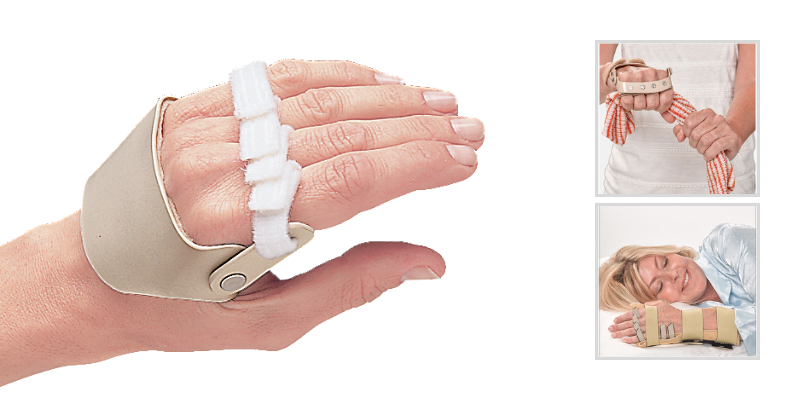
Oval-8 Finger Splints make treating a variety of finger conditions including Arthritis, Swan Neck Deformity or Trigger Finger comfortable and affordable. These easy-to-wear splints rely on a basic orthopedic principle - that it takes three points of pressure to stabilize or immobilize a joint. Employing this principle in the design, each Oval-8 splint treats a variety of conditions with a simple turn of the splint. And, Oval-8 splints have size adjustability designed right in to accomodate changes in swelling or temperature.

Oval-8 splints can be used to treat the following conditions and problems:
Ways to wear an Oval-8
Below are the most common finger conditions treated with an Oval-8:

  • Mallet or Baseball finger is the most common finger injury and is best treated by immobilizing the finger in a straight position full time for 4 to 6 weeks. Use an Oval-8 splint on the DIP joint (the end joint) to hold it in extension while still allowing the middle joint (PIP) to bend.
  • Swan Neck Deformity is one of the most common deformities caused by Rheumatoid Arthritis. Oval-8 finger splints block the hyperextension at the PIP (middle) joint but still allow the finger to bend for full hand function.
  • Jammed fingers are one of the most common injuries and are generally rested in full extension (straight). Use one or two Oval-8 finger splints to hold the PIP (middle) joint in extension.
  • Trigger Finger is a common overuse condition. Those with Trigger Finger experience a clicking or locking of the fingers when attempting to straighten them from a fisted position. Oval-8 finger splints reduce triggering by limiting finger flexion thus allowing the tendon the chance to rest and heal.
  • Boutonniere Deformity is often caused by a jamming or crush injury. In severe cases the middle finger bone tears through the tendon on the top of the finger known as the central slip. This tear causes the middle joint (PIP) to be stuck in flexion (bent towards the palm) and the end joint (DIP) bends backwards (hyperextends). Wearing one or two Oval-8 splints on the PIP joint holds it straight and still allows the DIP joint to bend.
  • A fracture is any break in the continuity of a bone. The most common finger fractures are usually the result of a crushing injury or a fall. Use one or two Oval-8 finger splints to immobilize and protect the finger.
  • Osteoarthritis can cause crooked (or deviated) fingers in the small joints of the fingers. An Oval-8 worn on the side of the joint can help straighten them and may prevent further deformity.

In addition to the common finger conditions listed above, Oval-8 finger splints can be used to treat the symptoms of other problems associated with arthritis, stroke, Cerebral Palsy and more, such as:
  • When experiencing a flare up of arthritis, an Oval-8 splint to help rest the joint(s) and reduce the effects of inflammation.
  • Provide stability for hypermobile joints for those with Ehlers Danlos Syndrome or other collagen disorders.
  • Use an Oval-8 f inger splint to improve positioning and prevent contractures for those with mild to moderate spasticity caused by stroke or cerebral palsy.
  • Improve finger posture in children learning how to properly hold writing utensils.

Below are links to more information about Oval-8 finger splints:
Oval-8 Finger Splints
Oval-8 Sizing Guide
How to treat a mallet finger with an Oval-8
Oval-8 FAQ's

Also check out our "Videos" page for additional information on how to size and modify Oval-8 splints.

We'd love to hear from you so please leave a comment below.

Swan Neck Deformity Explained


What is a Swan Neck deformity?
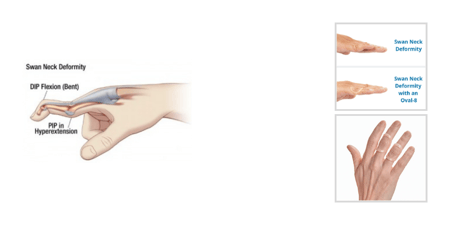
A Swan Neck deformity is a condition where the middle joint of the finger, known as the PIP joint, hyperextends or bends backwards and the end joint near the fingernail, known as the DIP joint, flexes or is bent downwards.

Swan Neck Deformity picture showing hyperextended PIP and flexed DIP joint

How do you get a Swan Neck deformity?
The most common causes of a Swan Neck deformity are a diagnosis of Rheumatoid Arthritis (RA), a ligament injury or an untreated Mallet or "Baseball" finger. Swan Neck deformity can also be a problem for people with a connective tissue disease known as Ehlers-Danlos Syndrome (EDS).

There is a thick ligament called the volar plate under the middle finger joint that keeps it from bending backwards. This ligament can be damaged by the inflammation common in Rheumatoid Arthritis and it can be torn when the finger is forcefully hyperextended. In addition to the volar plate, the tendons that act on the middle and end joint can be damaged or displaced by arthritis and by injuries such as Mallet finger injury or hyperextension.

Some people are born with loose or lax joints that are often misnamed "double jointed". This laxity allows the fingers to bend backwards without there being any injury and without it being a problem. But for persons with Ehlers-Danlos Syndrome, the fingers can hyperextend so much that it's difficult to bend the fingers.

How is a Swan Neck deformity treated?
Splinting the finger to stop the hyperextension is often all that is needed and can be a very successful long term solution. In more severe cases, surgery can be done to help realign the tendons and tighten the tissues around the joint.

What kind of splint options are there?
There are splints on the market designed to treat Swan Neck deformity. There are some different metal splints available, one made out of stainless steel and one made from silver. Because the steel splints can be hard to wear and the silver splints can be expensive, I designed a lightweight plastic splint called the Oval-8 Finger Splint.

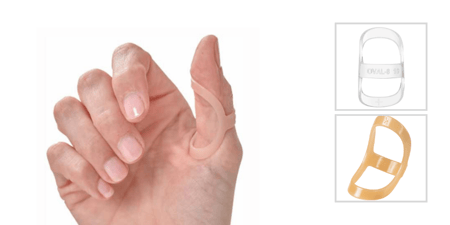
Oval-8 splints are designed to prevent hyperextension at the PIP joint but allow the finger to bend. They come in a broad range of sizes so they will fit almost any hand and are thin enough to be worn on several fingers at the same time if necessary. The wide bands make them comfortable to wear and depending on skin color, they can almost disappear on your finger. Oval-8's are comfortable, cost effective and can be worn short term or permanently if needed.

describe the image
                                                 (Oval-8 Finger Splint)

How do I get an Oval-8 splint?
Oval-8 splints have to be sized and fitted by a health care provider to make certain the fit is correct and that you know how to care for your finger.

If your doctor or therapist does not know about Oval-8 splints, you and they can get more information by visiting the Oval-8 page. It includes a video that shows how the Oval-8 is fit for a Swan Neck deformity.

You can even look for a hand surgeon or hand therapist near you who might have the Oval-8's and will be able to fit you by going to the "About Us" page. There are links for finding hand therapists or orthopedic doctors at the bottom of that page.

Author: Julie Belkin


Osteo Arthritis (OA) & Rheumatoid Arthritis (RA): A Brief Description


The word arthritis comes from the root word for joint “arthro” and “itis” meaning inflammation, combining to mean joint inflammation. Arthritis is a complex disorder that comprises more than 100 distinct conditions and can affect people at any age. Two of the most common forms are Osteoarthritis (OA) and Rheumatoid Arthritis (RA).

What is the Difference between Osteoarthritis and Rheumatoid Arthritis?

OA and RA have different causes and effects on the body, yet they often share a common symptom – persistent joint pain. The joint pain of arthritis can appear as knee or hip pain, hand pain, as well as joint pain in other areas of the body. Symptoms including stiffness and/or swelling in a joint for more than 2 weeks may indicate you have arthritis.

OA is caused by the breakdown and loss of the cartilage that covers and cushions the joints. Primary OA is related to aging – the simple wear and tear we all experience over time. OA can affect multiple joints including the hands, feet, spine and large weight bearing joints. Primary OA also may have a hereditary or genetic component – it your mother and father both have OA; there is an increased likelihood you will develop it also.

OA that is caused by a specific injury or condition is called Secondary OA. A previous injury to a joint, severe obesity or diabetes can be contributing factors to developing arthritis.

Rheumatoid Arthritis (RA) is a distinctly different disease. RA is an autoimmune disease that causes ongoing inflammation of the joints. Autoimmune diseases occur when the immune system mistakenly “attacks” the body’s tissues believing there is something wrong with them. RA not only affects the joints, it can also inflame the tissues around the joints as well as other organs in the body. For this reason, RA is called a systemic disease meaning it can affect multiple body systems.

Joint damage from RA can be much more extensive than just cartilage damage. In some cases, the cartilage, bone and ligaments can be destroyed leaving severely deformed joints. RA most commonly affects the hands and feet first. As the disease progresses, the shoulders, elbows, knees, hips and even jaw and neck can become involved. Unlike OA, the symptoms of RA are more likely to affect the same joints on both sides of the body.

How Do I Know Which One I Have?

The most common symptoms of OA include steady or intermittent pain in a joint, stiffness after periods of inactivity, especially sleeping or sitting, swelling or tenderness in a joint or joints and crunching sounds or sensations when moving a joint.

Symptoms of RA differ from person to person but generally include: Joint tenderness, warmth, and swelling. Both sides of the body are usually affected at the same time. Other symptoms include pain and stiffness in the morning that lasts for more than one hour, fatigue, occasional fever and a general sense of not feeling well.

Your health care provider can help determine what form of arthritis you have an how best to treat it. Remember that there are over 100 forms of arthritis and a proper diagnosis is the key to the right treatment.

Author: Julie Belkin


All Posts