Sign Up for E-mail Updates

Please fill in the information below if you would like us to notify you when new blogs are posted.

Topics of interest to you!

Are you a...: *


3-Point Products' Healthcare Blog

Current Articles | RSS Feed RSS Feed

Swan Neck Deformity Explained

  | Share on Twitter Twitter | Share on Facebook Facebook | Buzz This  Google Buzz | Submit to Digg digg it |  Add to delicious  delicious |  Submit to StumbleUpon StumbleUpon |  Share on LinkedIn LinkedIn | Submit to Reddit reddit 

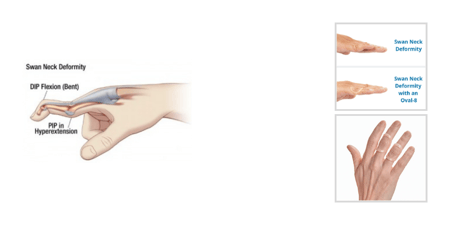
                  Swan Neck Deformity picture showing hyperextended PIP and flexed DIP joint

What is a Swan Neck deformity?
A Swan Neck deformity is a condition where the middle joint of the finger, known as the PIP joint, hyperextends or bends backwards and the end joint near the fingernail, known as the DIP joint, flexes or is bent downwards.

How do you get a Swan Neck deformity?
The most common causes of a Swan Neck deformity are a diagnosis of Rheumatoid Arthritis (RA), a ligament injury or an untreated Mallet or "Baseball" finger. Swan Neck deformity can also be a problem for people with a connective tissue disease known as Ehlers-Danlos Syndrome (EDS).

There is a thick ligament called the volar plate under the middle finger joint that keeps it from bending backwards. This ligament can be damaged by the inflammation common in Rheumatoid Arthritis and it can be torn when the finger is forcefully hyperextended. In addition to the volar plate, the tendons that act on the middle and end joint can be damaged or displaced by arthritis and by injuries such as Mallet finger injury or hyperextension.

Some people are born with loose or lax joints that are often misnamed "double jointed". This laxity allows the fingers to bend backwards without there being any injury and without it being a problem. But for persons with Ehlers-Danlos Syndrome, the fingers can hyperextend so much that it's difficult to bend the fingers.

How is a Swan Neck deformity treated?
Splinting the finger to stop the hyperextension is often all that is needed and can be a very successful long term solution. In more severe cases, surgery can be done to help realign the tendons and tighten the tissues around the joint.

What kind of splint options are there?
There are splints on the market designed to treat Swan Neck deformity. There are some different metal splints available, one made out of stainless steel and one made from silver. Because the steel splints can be hard to wear and the silver splints can be expensive, I designed a lightweight plastic splint called the Oval-8 Finger Splint.

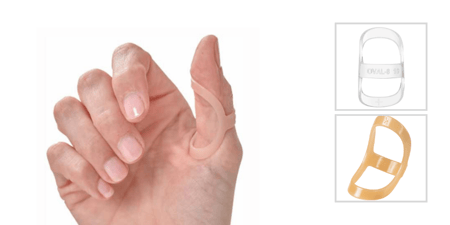
                                            Oval-8 finger splint for swan neck deformity prevents hyperextension of PIP joint

Oval-8 splints are designed to prevent hyperextension at the PIP joint but allow the finger to bend. They come in a broad range of sizes so they will fit almost any hand and are thin enough to be worn on several fingers at the same time if necessary. The wide bands make them comfortable to wear and depending on skin color, they can almost disappear on your finger. Oval-8's are comfortable, cost effective and can be worn short term or permanently if needed.

                                              Oval-8 finger splints help with swan neck deformity, mallet finger, lateral deviation and ligament injuries

How do I get an Oval-8 splint?
Oval-8 splints have to be sized and fitted by a health care provider to make certain the fit is correct and that you know how to care for your finger.

If your doctor or therapist does not know about Oval-8 splints, you and they can get more information by visiting the Oval-8 page on this web site. It includes a video that shows how the Oval-8 is fit for a Swan Neck deformity.

You can even look for a hand surgeon or hand therapist near you who might have the Oval-8's and will be able to fit you by going to the "About Us" page. There are links for finding hand therapists or orthopedic doctors at the bottom of that page.

Author: Julie Belkin


All Posts