Posted on Fri, Aug 06, 2010 @ 12:42 PM
Julie Belkin, founder and president of 3-Point Products (pictured in the center), was interviewed on television about her experience as someone who suffers from arthritis, has treated arthritis patients as an occupational therapist and founded a company that focuses primarily on arthritis-related products. She has designed a number of arthritis splints for fingers, thumbs and wrists, some of which she wears herself. Among other things, the video shows her discussing two of these splints and a reacher, a type of product Ms. Belkin recommends to every household.
The timing of this television interview was tied to National Arthritis Month (every May). Megan Pringle, co-anchor on the Baltimore ABC affiliate WMAR-TV's "Good Morning Maryland" program, conducted the interview. The inteview with Julie Belkin is the second half of the 8-minute video clip below.
The first half of the video features Jamie Costello interviewing Dr. Mark Deitch of the Orthomaryland Medical Group. Dr. Deitch's specialty is orthopaedics of the hand. He discusses which joints are most commonly affected by arthritis, different forms of arthritis and various treatment options. Arthritis treatment options include medications, splints & braces, injections and surgery. The main goals of arthritis treatment, according to Dr. Deitch, are improving function and reducing arthritis pain.
Watch the video here:
Here is a link to a summary of the interviews about arthritis and what can help. If you found this informative, please let the ABC station know by leaving a comment on their web site so they can consider your feedback when planning future programs.
You can also leave a comment below.
Posted on Fri, Feb 19, 2010 @ 03:01 PM
How is a Trigger Finger treated?
The treatments for a trigger finger include taking anti-inflammatory medicines like aspirin or ibuprofen, wearing a splint that limits how much the finger can bend, or getting a cortisone injection from your doctor. Sometimes, all 3 methods may be combined to try and stop the triggering.
If splinting and cortisone injections fail to stop the problem, surgery may be needed to remove the inflamed or scarred tissues and free up the tendon.
What kind of splint options are there?
There are a variety of splint options available, with the best option being a splint that prevents the finger from bending to the point where it triggers but still allows you to use your hand.
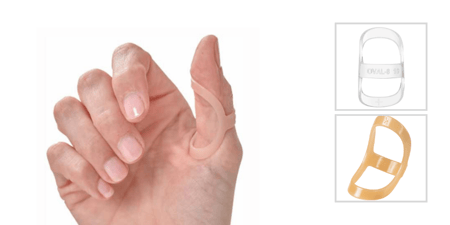
Oval-8 Finger Splints are a great solution as they can be worn to prevent the finger from bending all the way but still allow you to use your hand. They are easy to wear and if you have any pain or tenderness in the palm they can be cushioned with a gel sleeve to prevent pressure over the tendon.
By limiting how far the finger bends, the tendon is less likely to get caught in the pulley or sheath and it has the chance to rest and heal. Oval-8 splints can be worn during the day and at night and they can be used after the finger has been injected to allow the finger to rest and the injection to be fully effective.
How do I get an Oval-8?
Oval-8 splints have to be sized and fit by a health care provider to make certain the fit is correct and that you know how to care for your finger. If your doctor or therapist doesn't know about Oval-8 splints, you can get more information by visiting the Oval-8 finger splint page, which includes a video on all of the conditions that can be treated by Oval-8 splints, how the splint is fitted for a Trigger finger and how it can be modified by a therapist or doctor.
You can even find the name of a hand surgeon or hand therapist near you who might have the Oval-8's and will be able to fit you and order you a splint by visiting the links found on the About Us page.
Author: Julie Belkin
Posted on Fri, Feb 19, 2010 @ 12:40 PM
What is a Swan Neck deformity?
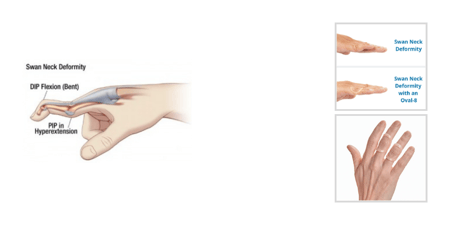
A Swan Neck deformity is a condition where the middle joint of the finger, known as the PIP joint, hyperextends or bends backwards and the end joint near the fingernail, known as the DIP joint, flexes or is bent downwards.
How do you get a Swan Neck deformity?
The most common causes of a Swan Neck deformity are a diagnosis of Rheumatoid Arthritis (RA), a ligament injury or an untreated Mallet or "Baseball" finger. Swan Neck deformity can also be a problem for people with a connective tissue disease known as Ehlers-Danlos Syndrome (EDS).
There is a thick ligament called the volar plate under the middle finger joint that keeps it from bending backwards. This ligament can be damaged by the inflammation common in Rheumatoid Arthritis and it can be torn when the finger is forcefully hyperextended. In addition to the volar plate, the tendons that act on the middle and end joint can be damaged or displaced by arthritis and by injuries such as Mallet finger injury or hyperextension.
Some people are born with loose or lax joints that are often misnamed "double jointed". This laxity allows the fingers to bend backwards without there being any injury and without it being a problem. But for persons with Ehlers-Danlos Syndrome, the fingers can hyperextend so much that it's difficult to bend the fingers.
How is a Swan Neck deformity treated?
Splinting the finger to stop the hyperextension is often all that is needed and can be a very successful long term solution. In more severe cases, surgery can be done to help realign the tendons and tighten the tissues around the joint.
What kind of splint options are there?
There are splints on the market designed to treat Swan Neck deformity. There are some different metal splints available, one made out of stainless steel and one made from silver. Because the steel splints can be hard to wear and the silver splints can be expensive, I designed a lightweight plastic splint called the Oval-8 Finger Splint.
Oval-8 splints are designed to prevent hyperextension at the PIP joint but allow the finger to bend. They come in a broad range of sizes so they will fit almost any hand and are thin enough to be worn on several fingers at the same time if necessary. The wide bands make them comfortable to wear and depending on skin color, they can almost disappear on your finger. Oval-8's are comfortable, cost effective and can be worn short term or permanently if needed.
How do I get an Oval-8 splint?
Oval-8 splints have to be sized and fitted by a health care provider to make certain the fit is correct and that you know how to care for your finger.
If your doctor or therapist does not know about Oval-8 splints, you and they can get more information by visiting the Oval-8 page on this web site. It includes a video that shows how the Oval-8 is fit for a Swan Neck deformity.
You can even look for a hand surgeon or hand therapist near you who might have the Oval-8's and will be able to fit you by going to the "About Us" page. There are links for finding hand therapists or orthopedic doctors at the bottom of that page.
Author: Julie Belkin
Posted on Tue, Jul 14, 2009 @ 09:38 AM
Anyone who has hit their fingertip against a door or wall or closed a drawer on their finger is lucky if they did not sustain what is commonly known as a Mallet Finger. Named for the position the end of the finger assumes, a Mallet Finger occurs when the tendon that straightens the DIP joint (the small joint near the fingernail) is torn or broken from its attachment.
A Mallet Finger, sometimes called a baseball finger, is a condition in which the end joint of a finger bends but will not straighten. The finger can be pushed straight but will not stay straight without support.
The standard treatment for a Mallet Finger is to hold it in a straight position full time for 4 to 6 weeks to allow the end of the tendon to heal back in place. Typically the doctor may use a wooden stick, aluminum strip or plastic tube splint to hold the finger straight. While these treatments are reasonably successful if followed for the full 4-6 weeks, they are inconvenient and often cause skin problems due to the tape necessary to hold them in place and the lack of air that gets to the fingertip.
There are some newer options on the market. Some are strips that fit on the top of the finger so the fingertip is free. The Oval-8 Finger Splint is an open design plastic splint that leaves the fingertip free and allows the skin to breath. The Oval-8 allows function and does not impede hand washing. Oval-8 splints must be fit to the finger so it is best to ask your health care provider about this splint as an option to treat a Mallet finger.
Author: Julie Belkin