Sign Up for E-mail Updates

Please fill in the information below if you would like us to notify you when new blogs are posted.

Topics of interest to you!

Are you a...: *


3-Point Products' Healthcare Blog

Current Articles | RSS Feed RSS Feed

2010 Arthritis Walk – Annapolis, MD

  | Share on Twitter Twitter | Share on Facebook Facebook | Buzz This  Google Buzz | Submit to Digg digg it |  Add to delicious  delicious |  Submit to StumbleUpon StumbleUpon |  Share on LinkedIn LinkedIn | Submit to Reddit reddit 


3-Point Products is one of the local sponsors of the Arthritis Walk at Quiet Waters Park near Annapolis, MD, on May 15th, 2010.  The event, which takes place during National Arthritis Month, is set up to raise awareness of arthritis and funds for the Arthritis Foundation’s efforts to fight arthritis. The Arthritis Foundation is described on the Arthritis Walk’s web site as “the leading health organization addressing the needs of some 46 million Americans living with arthritis, the nation’s most common cause of disability”.


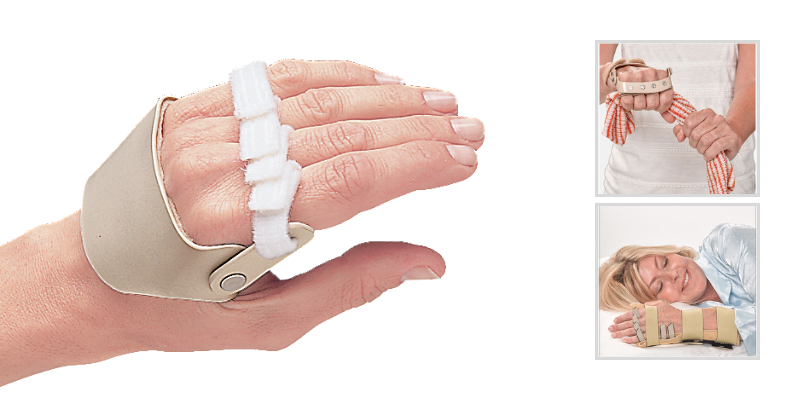
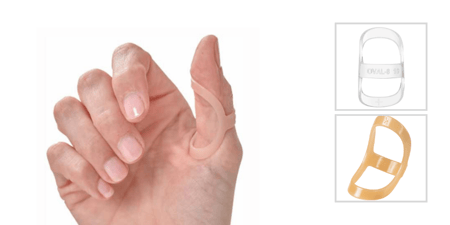
3-Point Products will have several products on display to try out, including our Oval-8® finger splints – used for 6 different indications - and the 3pp™ ThumSling™, a popular product for increasing function in those with CMC or basal joint arthritis.


Come join us between 7:30 am and 11 am at:

Quiet Waters Park

600 Quiet Waters Road

Annapolis, MD


The forecast is sunny and 72°F.


You can link to the event information page on the Arthritis Walk website here.


Fundraising guidelines can be found here.


Top 10 adaptive products to help with arthritis – Part 2

  | Share on Twitter Twitter | Share on Facebook Facebook | Buzz This  Google Buzz | Submit to Digg digg it |  Add to delicious  delicious |  Submit to StumbleUpon StumbleUpon |  Share on LinkedIn LinkedIn | Submit to Reddit reddit 

As I mentioned in my previous blog, there are lots of products available to make living with arthritis easier. Therapists call them adaptive devices, or ADL’s, which stands for Aids to Daily Living. Some you my have heard of, others you may not have or you may not have thought of alternative uses.

The previous blog covered self-opening scissors, alternative uses for wet towels and for pliers, as well as slip-resistant Dycem and quality pens.

Here is the second half of my TOP 10 list of adaptive items to help with arthritis.

6. A long-handled reacher

            Pick-Up reacher for people with minimal grip strength                   Handi-Reacher

         (image of Handi-Reacher courtesy of Sammons Preston, a division of Patterson Medical, Inc.)  

Every household should have a long handled reacher. It does not matter if you don’t have arthritis, back pain, or you are tall enough to reach the ceiling, a reacher should be a standard household tool. When selecting a reacher, try to find one that requires all fingers to engage the mechanism. They are easier to use.

There is always a space between cupboards or next to the washer that something is certain to fall into. A narrow long handled reacher makes it easy to grasp the envelope that slipped between the cupboard and the stove, to pick up the sock that would otherwise go into the “disappeared” pile next to the dryer, and to pull that roll of paper towel to the edge of a just too high shelf. My reacher hangs in my pantry/laundry closet and it sees regular use. I have big pine trees in my backyard and my reacher is the ideal tool to pick up the hundreds of pine cones that fall each year without me having to bend down hundreds of times to clean the yard.

7. Bath Mitts

                                        Sponge Wash Mitt
     (image of Sponge Wash Mitt courtesy of Sammons Preston, a division of Patterson Medical, Inc.)

A wash mitt beats a wash cloth every time. Slip it on one hand, soap it up and you are done trying to keep a grip on the cloth and keep it soaped up. Simply switch hands as needed and bathing becomes just a bit less stressful for your hands especially if you have arthritis. Combined with my number 3 choice, a bath chair, showering or bathing is safer and more comfortable and you have a few extra moments to just let the warm water soak sore joints and bones.

8. A Shower or Bath Chair

                                      Shower Chair

      (image of Shower Chair courtesy of Sammons Preston, a division of Patterson Medical, Inc.)

A simple seat or bath bench is ideal for relaxing and safe bathing. The model shown folds so it is easy to take in and out of the tub or shower and can be stored out of the way if needed. Sitting makes it easier and safer to reach your feet with

the bath mitt and it allows you to get a good relaxing soak.

9. Stocking or Sock Aid

                             Stocking or Sock Aid

                                              (image courtesy of North Coast Medical)

If you have arthritis, back pain or mobility problems and reaching your feet or holding open a sock is difficult, Sock aids really do work. The one shown here has a flat bottom to allow your foot to slide in and out of it easily. It is effective with all but really tight compression stockings. You can search for this aide under the name Sock-Assist. For true confession’s sake, even though my company does not carry this aide, I did design it for the company who makes it and it was my first patent. And it works, so I can safely recommend it.

10. Work gloves with a gripping surface

                                        Work gloves                     

Gloves that have a silicone or rubber gripping surface make a lot of tasks easier and safer. There are a variety of lightweight gloves that are easy to slip on an off and can be used for many tasks. If you have arthritis or you don’t, the gripping surface makes it easier to hold things so you apply less force and therefore less stress on your hands and arms. If your hand strength is diminished, gripper gloves make tasks such as slicing meat or picking up heavy vases or books, easier and safer.

These are great when vacuuming or sweeping and my mother takes them with her to the grocery store so she can safely take cans off the shelf and lift heavy juice containers into her cart. The gloves pictured above are just two of the many brands available.

So now I have given you my Top 5 picks plus my next Top 5 picks for items that really do make it safer and less stressful to perform daily activities. If you have arthritis, diminished mobility or strength or like me, just don’t want to add more stress on an aging body than I have to, these are good things to have and use.

There are other well designed products that can be very helpful. When deciding what you might want to have in your house, your purse or your car to make it easier to get through your day with less physical stress, ask yourself these questions:

  1. Is this something that will help me do something I can’t really do anymore?
  2. Will I use it regularly?
  3. If my friends see me using this will they want one too?

If you answer yes to any of these questions – buy it.

What are your favorite “tools” to make living with arthritis easier? Share them in the comments below.

Author: Julie Belkin


Top 10 Adaptive Products To Help With Arthritis - Part 1

  | Share on Twitter Twitter | Share on Facebook Facebook | Buzz This  Google Buzz | Submit to Digg digg it |  Add to delicious  delicious |  Submit to StumbleUpon StumbleUpon |  Share on LinkedIn LinkedIn | Submit to Reddit reddit 

Q. Can “knick knacks” really make my arthritic hands feel better?

A. Yes and no. Knick knacks or more formally, adaptive devices or equipment, reduce pain if they decrease the amount of force you use when opening jars, hold a pen or comb your hair. Equipment will not cure your arthritis but can help lessen the progression and make doing daily activities less painful and less stressful on an affected joint.

Q. Which equipment works the best for people with arthritis?

A. As a practicing occupational therapist I spent a good deal of time choosing the most appropriate equipment for my patients and showing them how to use it. In general, the equipment I liked the best was usually the simplest and often things you already have in your home.

The more “stuff” you have, the less you will tend to use so I like to keep it simple and to a minimum. There are some great products available that really make a difference when your hands are weak or in pain. I have a top 10 list of products that make living with arthritis easier. The top 5 are shown below. The next 5 will be in a future blog. So here goes my list of the TOP 5 adaptive products for arthritis:

  1. Self-opening loop scissors

                                          Loop Scissors
         (image of  Loop Scissors courtesy of Sammons Preston, a division of Patterson Medical, Inc.)

With looped scissors you do not need to try fitting sore or enlarged fingers in two small handle holes. The self-opening scissors require about 1/2 the amount of strength to open than do regular scissors. Mine stay in my kitchen utensil organizer so they are readily at hand. They won’t cut a chicken but they are great at cutting coupons, any paper, tape or string.

  1. A damp towel

                                damp towel to make work in the kitchen easier with arthritis in your hands

                            (image of terry cloth towels courtesy of North Coast Medical, Inc.)

Everybody has a towel and most every kitchen or bathroom has a damp towel. Placing bowls or cups on a damp towel keeps them from moving when you are using two hands to stir a bowl or pour from a pot. A damp towel helps you grip a jar to open it or to pour from. A damp towel is a good resting spot for a warm cookie sheet when you are trying to remove stuck cookies. A damp towel makes clean up easy so you don’t have to scrunch up a sponge or paper towel. And a damp towel will dry quickly or go into the washing machine and come out ready to use again.

  1. Slip resistant Dycem® strips or mats

            Dycem self-adhesive matting to increase friction and stability        Dycem self-adhesive matting to increase friction and stability

(image of Dycem Pressure-Sensitive Strips courtesy of Sammons Preston, a division of Patterson Medical, Inc.)

Dycem® is a non-slip material that comes in sheets to be used as non-slip mats and it comes in self-adhesive strips to wrap around utensils or handles. The added friction provided by Dycem material ensures that you use less strength to hold or manipulate something. For instance, you can wrap a strip around a round doorknob to make it easier to open or around your favorite mixing spoon to make it easier to hold. Wrap a strip of Dycem onto a cane or walker handle for better security or around the refrigerator or oven door to make it easier to open. Dycem should be washed or rinsed regularly for it to maintain its non-slip surface.

  1. Narrow pliers
  2.           
                                     Needle Nose Pliers
(image of Economy Needle-Nose Pliers/Wire Cutters courtesy of Sammons Preston, a division of Patterson Medical, Inc.)

Needle nose pliers are useful in a variety of locations. Use them to pull the cotton out of those small annoying medicine bottles. Use them to hold one end of a bracelet or necklace while you fasten it. Needle nose pliers make holding most small items less stressful on your hands.

  1. A quality pen

While some people like to recommend built up pens or pencils, my advice is to buy a good pen with quality ink that flows easily and needs minimal pressure to write clearly. A built up pen that writes poorly is harder to hold and write with than a thinner, better quality pen. If you tend to lose pens, use a sticky label to add your name to make it easier to identify and remember. Always keep the pen in one place and always return it to that place when you are done. You do not need to spend a fortune on a pen but a 15 cent office store pen will never be worth the 15 cents you spent when your thumb is too sore to write with it.

As for the next 5 items on my top-10 list of products that can make living with arthritis easier, look for the next blog.

Do you use products that help make your life with arthritis easier? Share them in the comments below to help others.

Author: Julie Belkin


Osteo Arthritis (OA) & Rheumatoid Arthritis (RA): A Brief Description

  | Share on Twitter Twitter | Share on Facebook Facebook | Buzz This  Google Buzz | Submit to Digg digg it |  Add to delicious  delicious |  Submit to StumbleUpon StumbleUpon |  Share on LinkedIn LinkedIn | Submit to Reddit reddit 

The word arthritis comes from the root word for joint “arthro” and “itis” meaning inflammation, combining to mean joint inflammation. Arthritis is a complex disorder that comprises more than 100 distinct conditions and can affect people at any age. Two of the most common forms are Osteoarthritis (OA) and Rheumatoid Arthritis (RA).

What is the Difference between Osteoarthritis and Rheumatoid Arthritis?

OA and RA have different causes and effects on the body, yet they often share a common symptom – persistent joint pain. The joint pain of arthritis can appear as knee or hip pain, hand pain, as well as joint pain in other areas of the body. Symptoms including stiffness and/or swelling in a joint for more than 2 weeks may indicate you have arthritis.

OA is caused by the breakdown and loss of the cartilage that covers and cushions the joints. Primary OA is related to aging – the simple wear and tear we all experience over time. OA can affect multiple joints including the hands, feet, spine and large weight bearing joints. Primary OA also may have a hereditary or genetic component – it your mother and father both have OA; there is an increased likelihood you will develop it also.

OA that is caused by a specific injury or condition is called Secondary OA. A previous injury to a joint, severe obesity or diabetes can be contributing factors to developing arthritis.

Rheumatoid Arthritis (RA) is a distinctly different disease. RA is an autoimmune disease that causes ongoing inflammation of the joints. Autoimmune diseases occur when the immune system mistakenly “attacks” the body’s tissues believing there is something wrong with them. RA not only affects the joints, it can also inflame the tissues around the joints as well as other organs in the body. For this reason, RA is called a systemic disease meaning it can affect multiple body systems.

Joint damage from RA can be much more extensive than just cartilage damage. In some cases, the cartilage, bone and ligaments can be destroyed leaving severely deformed joints. RA most commonly affects the hands and feet first. As the disease progresses, the shoulders, elbows, knees, hips and even jaw and neck can become involved. Unlike OA, the symptoms of RA are more likely to affect the same joints on both sides of the body.

How Do I Know Which One I Have?

The most common symptoms of OA include steady or intermittent pain in a joint, stiffness after periods of inactivity, especially sleeping or sitting, swelling or tenderness in a joint or joints and crunching sounds or sensations when moving a joint.

Symptoms of RA differ from person to person but generally include: Joint tenderness, warmth, and swelling. Both sides of the body are usually affected at the same time. Other symptoms include pain and stiffness in the morning that lasts for more than one hour, fatigue, occasional fever and a general sense of not feeling well.

Your health care provider can help determine what form of arthritis you have an how best to treat it. Remember that there are over 100 forms of arthritis and a proper diagnosis is the key to the right treatment.

Author: Julie Belkin


My Thumb Hurts. Do I Have Thumb Arthritis?

  | Share on Twitter Twitter | Share on Facebook Facebook | Buzz This  Google Buzz | Submit to Digg digg it |  Add to delicious  delicious |  Submit to StumbleUpon StumbleUpon |  Share on LinkedIn LinkedIn | Submit to Reddit reddit 

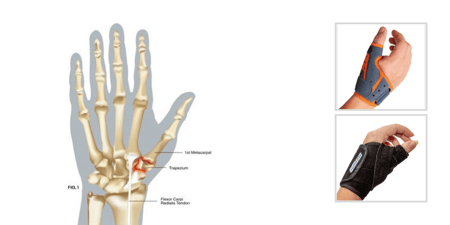
If you feel pain at the base of your thumb (down by the wrist) when you pinch or grasp something, you may have arthritis of the basal or CMC joint. This very unique joint is the most common site for arthritis in the hand. If you are a woman over the age of 40 (and willing to admit it), you stand a higher than average chance of having thumb arthritis. There are other conditions that can also cause pain around the base of the thumb so it is important to discuss the problem with your health care provider.

The good news is - there are things you can do to alleviate the pain and lessen the progression of the arthritis.

Stages of arthritis

Like any other type of arthritis, CMC joint arthritis can be mild or very severe, interfering in your ability to perform daily activities. As a therapist deciding how to treat someone, I break thumb arthritis down into three stages.

Stage 1
At the onset of CMC joint arthritis, you may feel a "grabbing" or sharp pain only when you start doing an activity. You may find the pain diminishes once the activity gets underway only to return when you stop the activity. This occasional pain is easy to ignore - but I don't advise it.

Stage 2
As the arthritis progresses, pain may be present with even light activity or at rest. You may also experience pain and tenderness when you touch the joint. At this point you may notice the base of the thumb "sticking out" and looking as though it is a little ledge or step. Now if there were any doubt you have CMC arthritis, your thumb is definitely telling you otherwise.

Stage 3
In later stages, the thumb can assume a few different "crooked" postures. When the middle knuckle of the thumb (the MCP joint at the level of the web space) is flexed or bent, and the end or IP joint is hyperextended, it is called a Boutonniere Deformity.

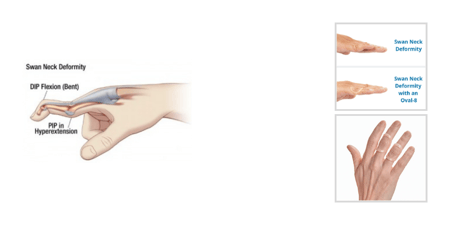
The opposite of this posture is a Swan Neck deformity. The MCP is hyperextended and it may be difficult to move he thumb sideways, opening the web space. With time, the skin in the web can shrink, making it impossible to open the thumb away from the palm.

In late stages, pain may actually decreases but the deformity impairs function and strength is greatly diminished.

Is there anything I can do not to end up with Stage 2 or Stage 3 arthritis?

It would be really nice to be able to say - if you take this pill, wear this splint, or do this exercise, the arthritis will not progress or it may even go way. Unfortunately for those with a family history of arthritis or those who just did not win the toss of the die for long lived, healthy bones, the disease may progress despite the best care.

What you can do however, is learn to use your hands so they take less stress, use devices that help you perform daily tasks with less stress, and wear functional splints or braces that support the joint.

Even at the very early stages of CMC arthritis, wearing a support that applies light compression and helps maintain the integrity of the joint, can really help relieve pain and allow better function.

I can't wear a hard splint and still work. Are there other options?

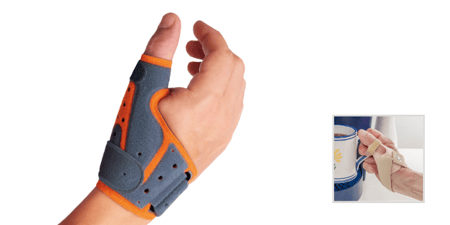
Yes, there are a variety of options in soft splints. There are several companies that use Neoprene (the same fabric skin divers wear) that apply compression and restrict some motion, but still allow enough motion to be able to function. Liberty and Comfort Cool splints from North Coast Medical and Freedom splints from Alimed are some brands of Neoprene splints. There are other lighter weight foam lined splints that provide cushioning, support and light compression with only slight restriction on motion. 3pp splints from 3-Point Products offer some very functional options in lightweight thumb and wrist splints.

The important thing to know is that you can do something to decrease the pain and reduce stress to try and limit future deformity and dysfunction.

Future blogs will discuss joint protection techniques and the "adaptive equipment" everyone should be using. Another blog is planned to discuss surgical options for those in stage 3 where splints only provide some relief and who need more than a splint and equipment can provide.

Author: Julie Belkin


All Posts