Sign Up for E-mail Updates

Please fill in the information below if you would like us to notify you when new blogs are posted.

Topics of interest to you!

Are you a...: *


3-Point Products' Healthcare Blog

Current Articles | RSS Feed RSS Feed

3-Point Products Founder Discusses Arthritis Products on Television

  | Share on Twitter Twitter | Share on Facebook Facebook | Buzz This  Google Buzz | Submit to Digg digg it |  Add to delicious  delicious |  Submit to StumbleUpon StumbleUpon |  Share on LinkedIn LinkedIn | Submit to Reddit reddit 

                 3-Point Products President Interviewed on ABC News Arthritis 


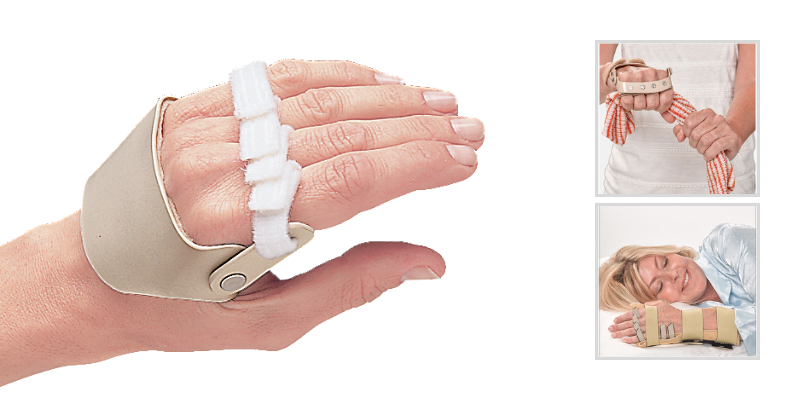
Julie Belkin, founder and president of 3-Point Products (pictured in the center), was interviewed on television about her experience as someone who suffers from arthritis, has treated arthritis patients as an occupational therapist and founded a company that focuses primarily on arthritis-related products.  She has designed a number of arthritis splints for fingers, thumbs and wrists, some of which she wears herself. Among other things, the video shows her discussing two of these splints and a reacher, a type of product Ms. Belkin recommends to every household.

The timing of this television interview was tied to National Arthritis Month (every May).  Megan Pringle, co-anchor on the Baltimore ABC affiliate WMAR-TV's "Good Morning Maryland" program, conducted the interview. The inteview with Julie Belkin is the second half of the 8-minute video clip below.

The first half of the video features Jamie Costello interviewing Dr. Mark Deitch of the Orthomaryland Medical Group. Dr. Deitch's specialty is orthopaedics of the hand. He discusses which joints are most commonly affected by arthritis, different forms of arthritis and various treatment options. Arthritis treatment options include medications, splints & braces, injections and surgery.  The main goals of arthritis treatment, according to Dr. Deitch, are improving function and reducing arthritis pain.


Watch the video here:


Here is a link to a summary of the interviews about arthritis and what can help. If you found this informative, please let the ABC station know by leaving a comment on their web site so they can consider your feedback when planning future programs.

You can also leave a comment below.


My Thumb Hurts. Do I Have Thumb Arthritis?

  | Share on Twitter Twitter | Share on Facebook Facebook | Buzz This  Google Buzz | Submit to Digg digg it |  Add to delicious  delicious |  Submit to StumbleUpon StumbleUpon |  Share on LinkedIn LinkedIn | Submit to Reddit reddit 

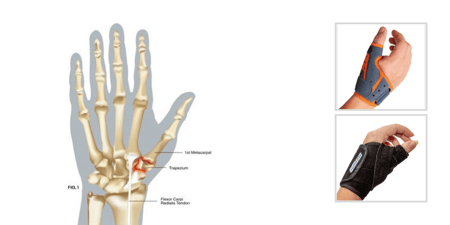
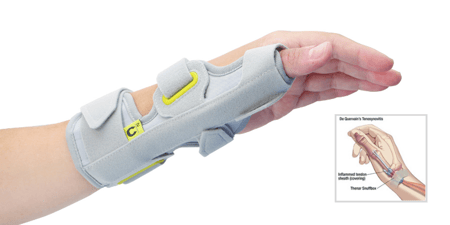
If you feel pain at the base of your thumb (down by the wrist) when you pinch or grasp something, you may have arthritis of the basal or CMC joint. This very unique joint is the most common site for arthritis in the hand. If you are a woman over the age of 40 (and willing to admit it), you stand a higher than average chance of having thumb arthritis. There are other conditions that can also cause pain around the base of the thumb so it is important to discuss the problem with your health care provider.

The good news is - there are things you can do to alleviate the pain and lessen the progression of the arthritis.

Stages of arthritis

Like any other type of arthritis, CMC joint arthritis can be mild or very severe, interfering in your ability to perform daily activities. As a therapist deciding how to treat someone, I break thumb arthritis down into three stages.

Stage 1
At the onset of CMC joint arthritis, you may feel a "grabbing" or sharp pain only when you start doing an activity. You may find the pain diminishes once the activity gets underway only to return when you stop the activity. This occasional pain is easy to ignore - but I don't advise it.

Stage 2
As the arthritis progresses, pain may be present with even light activity or at rest. You may also experience pain and tenderness when you touch the joint. At this point you may notice the base of the thumb "sticking out" and looking as though it is a little ledge or step. Now if there were any doubt you have CMC arthritis, your thumb is definitely telling you otherwise.

Stage 3
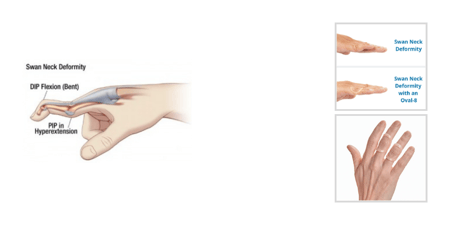
In later stages, the thumb can assume a few different "crooked" postures. When the middle knuckle of the thumb (the MCP joint at the level of the web space) is flexed or bent, and the end or IP joint is hyperextended, it is called a Boutonniere Deformity.

The opposite of this posture is a Swan Neck deformity. The MCP is hyperextended and it may be difficult to move he thumb sideways, opening the web space. With time, the skin in the web can shrink, making it impossible to open the thumb away from the palm.

In late stages, pain may actually decreases but the deformity impairs function and strength is greatly diminished.

Is there anything I can do not to end up with Stage 2 or Stage 3 arthritis?

It would be really nice to be able to say - if you take this pill, wear this splint, or do this exercise, the arthritis will not progress or it may even go way. Unfortunately for those with a family history of arthritis or those who just did not win the toss of the die for long lived, healthy bones, the disease may progress despite the best care.

What you can do however, is learn to use your hands so they take less stress, use devices that help you perform daily tasks with less stress, and wear functional splints or braces that support the joint.

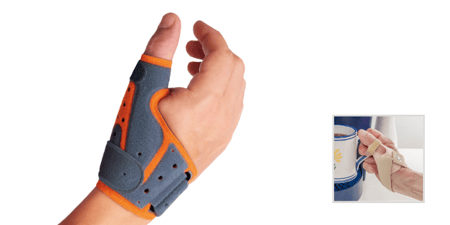
Even at the very early stages of CMC arthritis, wearing a support that applies light compression and helps maintain the integrity of the joint, can really help relieve pain and allow better function.

I can't wear a hard splint and still work. Are there other options?

Yes, there are a variety of options in soft splints. There are several companies that use Neoprene (the same fabric skin divers wear) that apply compression and restrict some motion, but still allow enough motion to be able to function. Liberty and Comfort Cool splints from North Coast Medical and Freedom splints from Alimed are some brands of Neoprene splints. There are other lighter weight foam lined splints that provide cushioning, support and light compression with only slight restriction on motion. 3pp splints from 3-Point Products offer some very functional options in lightweight thumb and wrist splints.

The important thing to know is that you can do something to decrease the pain and reduce stress to try and limit future deformity and dysfunction.

Future blogs will discuss joint protection techniques and the "adaptive equipment" everyone should be using. Another blog is planned to discuss surgical options for those in stage 3 where splints only provide some relief and who need more than a splint and equipment can provide.

Author: Julie Belkin


All Posts